
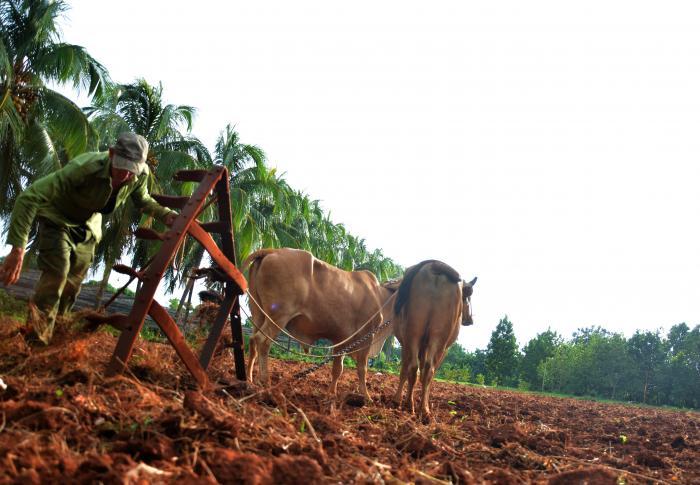
“The country is built from the furrow”
The First Secretary of the Communist Party Central Committee and President of the Republic, Miguel Díaz-Canel Bermúdez, reaffirmed his full confidence that, if there is one sector that must deliver results in the immediate term, it is agricultural and livestock production. We are now “more aware that we can do better, given all the possibilities offered by these transformations.”
He made these remarks to representatives of Cuban agriculture and livestock farming, with whom he held a meeting at the Convention Center to discuss the implementation of economic and social transformations within the sector.
Also present at the meeting were Roberto Morales Ojeda, member of the Political Bureau and Secretary of Organization of the Party Central Committee; José Ramón Monteagudo Ruiz, member of the Central Committee Secretariat and head of its Agri-food Department; and Deputy Prime Minister Jorge Luis Tapia Fonseca. The Head of State discussed how these transformations could be leveraged to accelerate food production.
ON POSITIVE EXPERIENCES, QUESTIONS, AND OBSTACLES
Deputy Minister of Agriculture Telce Abdel González Morera explained that 162 of the 176 economic and social transformations impact the national agricultural and livestock sector.
He noted that the sector is already benefiting from the updating of some twenty legal regulations. We are facing, he said, a comprehensive legal package that addresses all components of agricultural and livestock production: land, genetics, plant and animal health, technology, production, marketing, inputs, and more.
We now have—he asserted—a regulatory framework “that provides greater legal certainty for producers.”
Yoandris Beltrán Pérez, president of the Poultry Business Group (a Higher Organization of Business Management, or OSDE), spoke about the positive impact of the measures implemented; the group drastically reduced its headquarters staff by creating various service-providing MSMEs.
The transformations are steering the group toward operating through commercial companies and national and regional value chains; shifting its energy mix to include renewable energy sources; strengthening the genetic potential of the poultry stock; and expanding the marketing of breeding stock, among other measures. All these initiatives center on the workers—who are now more motivated—regarding both their implementation and their results, he stated.
For 2025, the Poultry Group had projected losses in the neighborhood of 2 billion pesos. However, for the current year, they have already accumulated profits of 56 million pesos.
Dianelis Saborido Pérez, General Director of the Emilio Córdova Agro-industrial Grain Enterprise in Villa Clara, highlighted how the combination of the 63 agricultural measures approved years ago and the recent economic and social transformations is having a very positive impact on the entity, which has seen an increase of over 2,000 hectares of rice cultivation.
For this season, the 11,068 hectares actually planted exceed the planned 10,880 hectares. Of particular note are the nearly 1,000 hectares managed by a non-state MSME, which is achieving yields of 4.5 tons of wet paddy rice per hectare.
At the Emilio Córdova facility, non-state management entities are handling not only agricultural land but also milling and drying operations. This has led to a cooperative rice production model where the processing industry completes the cycle; all parties—the state enterprise and the non-state MSMEs alike—benefit, as do the communities and social centers they support as part of their social responsibility initiatives, alongside the creation of new jobs.
Yoisel Pereda Milián, president of the Artemisa-based MSME Don Pereda, discussed his entity’s experience in raising weaned piglets; it is now set to enter a business partnership with the Artemisa Swine Enterprise to supply animals for fattening. Operations will rely on the intensive use of artificial insemination, renewable energy sources throughout the production process, and other efficiencies.
Fernando Ravelo Hernández, president of the Cuba-México CPA (Agricultural Production Cooperative) in Artemisa, admitted that it was difficult for him to accept the changes proposed in recent years.
He acknowledged having initially refused to link the cooperative with land usufructuaries and other external landholders; however, he and the board of directors have since adopted a more flexible stance and now maintain relationships with neighboring usufructuaries, providing them with irrigation and machinery services.
Abelardo Álvarez Silva, president of the Antero Regalado CCS (Credit and Services Cooperative) in Güira de Melena, described the transformations as very positive. However, he emphasized the need for training, noting that not all farmers fully grasp these changes; there are many questions, and we must not tire of explaining them.
He asked the country’s leadership to maintain these contacts “so we can track the results and also identify where we are getting stuck.”
THEY HAVE SHOWN THAT THERE IS A WAY FORWARD
President Díaz-Canel acknowledged that, “although this meeting has showcased positive ideas, positive interpretations of the transformations, and examples of what you are already doing and achieving, that is not the reality across the entire country. In other words, there are many things that are not moving forward; many things are still stalled.
“Often, when we have visited your farms or some of these state-run enterprises, we have seen that they achieved better results during more difficult times.”
They have succeeded—he reflected—because “they had the capacity to adapt, because they applied science and innovation, because they innovated in production processes, and because of the way they engage and organize work with their cooperative members or workers.”
“Many of you took actions that anticipated the transformations we have since approved. You have therefore demonstrated that there is a way forward—that even in difficult times, there is a path to success. The challenge now is how to scale up those successful experiences,” he insisted.
And now—Díaz-Canel stated—”it would be excellent if, by implementing these transformations swiftly, thoroughly, and coherently, we could soon achieve a substantial increase in food production that better meets our population’s needs, improves people’s purchasing power, and allows them to access the food they require at better prices.”
But to achieve this, “we must produce efficiently, make good use of the land, and establish a proper balance between expenses, costs, and prices,” the President emphasized.
Díaz-Canel reviewed in detail the range of transformations for the sector, which include modifying the land use and exploitation regime; recognizing alliances between individuals, legal entities, and state, private, or mixed enterprises; transforming the cooperative model by expanding the authority to import inputs, fuel, and other resources, as well as to export; and respecting cooperative autonomy, among other changes.
Now—he noted—there is genuine autonomy; furthermore, the Agricultural Development Fund is being decentralized to the local level, and a development and promotion bank is being created; foreign investment—as well as investment by Cubans living abroad—is being encouraged.
He shared with the producers an analysis of the sector’s current strengths, threats, weaknesses, and opportunities, as well as the interrelationships among the 23 pillars that structure the 176 transformations. He explained that, despite all these decisions, there will be no shortage of obstacles, and that is why “we need to maintain an exchange, and you must alert us to what is needed.”
Summarizing the discussion, Díaz-Canel noted that these transformations “give you the right to decide what is produced, how it is produced, in what quantities, and how it is marketed. That grants you autonomy, but it also places a tremendous responsibility on you, because if, in the end, food does not appear on Cuban families’ plates, people will not believe in the transformations.” At the same time, he pointed out, “other Cubans in other sectors will be responsible for driving forward other transformations from which you, too, will benefit.”
In this regard, the Head of State insisted that those in the agricultural sector must view themselves as “owners of the execution of these transformations”—the implementation of which could lead us “to a new phase in the country’s agricultural development and, consequently, in food sovereignty.” He urged them to uphold the principle that “the country is built from the furrow, not from an office or a desk.” Therefore, he stated, “the contribution you can make to the country is decisive.”
He defined the 176 economic and social transformations not merely as a “change in regulations,” but as a “change in logic.” It means “shifting from being mere executors of plans to becoming managers of the country’s food production destiny.”
“Today,” the President concluded, “land, inputs, marketing channels, and financing are closer to you than ever before. The law opens doors, but it is the producers who walk through them; the law alone does not provide the solution. Therefore, the call is for us to be ready for this challenge and to go out and achieve victory.” (Take from Granma)

