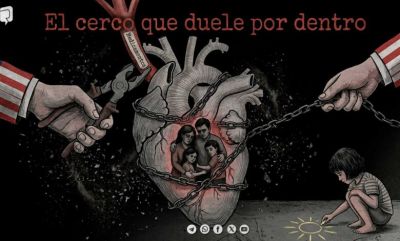
The Siege That Hurts Inside
There is a dimension of the blockade that rarely appears in economic statistics, but which inhabits every Cuban home with a silent persistence: the psychological damage. Not scarcity as a statistic, but as a lived experience. Not the number of missing medications, but the anxiety of those who don’t know if tomorrow there will be insulin at the pharmacy, fuel to get to work, or enough food for a family dinner.
Living under perpetual sanctions means living in structural uncertainty. And sustained uncertainty, when it has no visible end or cause that can be resolved from within, produces what clinical psychology identifies as chronic toxic stress: a state of permanent alert that wears down the nervous system, erodes mental health, and generates what some specialists call learned helplessness, the growing conviction that individual effort is not enough to change living conditions.
This is not a subjective interpretation. The UN Special Rapporteur on the Human Rights Council, Alena Douhan, has formally recognized the harmful effects of the blockade on the right to health in Cuba, explicitly including mental health. At the 20th Cuban Civil Society Forum Against the Blockade, data was presented demonstrating how this policy of accumulated hostility over more than six decades condemns the physical and mental health of patients and their families, creating an environment of prolonged stress that exacerbates any pre-existing conditions. The Pan American Health Organization itself has witnessed complaints from the Cuban government to international bodies, where the Ministry of Public Health has indicated that the blockade hinders the development and strengthening of the National Health System, affecting both the availability of medicines and the capacity to respond to health emergencies.
To this must be added the specific grief caused by family separation. Travel restrictions and the blockade on remittances are not just economic obstacles: they are prolonged emotional ruptures, premature grief, and relationships that deteriorate from afar under the pressure of a policy designed precisely for that purpose.
But the psychological damage of the blockade doesn’t operate in only one direction. Those who design, defend, and maintain it from Washington also reveal, in that political act, a mental architecture that deserves to be named.
To sustain a policy that produces hunger, deprives people of medical supplies, and drives mass emigration, it is necessary to activate psychological mechanisms of moral distancing. The first is blaming the victim: it is not our laws that cause the harm, it is the regime that is responsible. The second is the abstraction of suffering: there is no face of a child without milk, only statistics of economic pressure. The third, and perhaps the most dangerous, is ideological fanaticism in its most classic form: the conviction that the end, the change of government in Cuba, justifies any means, including prolonged civil suffering.
On an individual level, some of these officials likely experience what psychology describes as cognitive dissonance: they know the policies they defend cause harm, but they construct justifications that allow them to maintain them without any visible moral rupture. Others, the most worrying, don’t need this mechanism because they have completely deactivated their empathy for the victim, whom they perceive not as a concrete human being but as a variable in a geopolitical calculation.
In political terms, the blockade exhibits traits of what some analysts identify as an institutionalized, sadistic exercise of power: the objective is not only economic pressure as a means to an end, but the constant demonstration of dominance, the reaffirmation of who can restrict, reprimand, and blockade with impunity. The siege as a message. Harm as a language.
The blockade is not just a catalog of prohibited items or a list of sanctioned entities. It is a systematic psychological war aimed at breaking the morale of a people, at making them feel that their condition is their own fault or an inevitable fate. The invisible damage, the silent depression, the accumulated powerlessness, the rage that finds no outlet, is as real and as measurable as the lack of reagents in a laboratory or fuel at a power plant.
Those who have chosen to uphold this policy from Washington, knowing what it produces, have also chosen to look the other way while their decision sows trauma in generations of Cubans. Historically, this choice has a precise legal name: crime against humanity.
The economic blockade is also a blockade of mental health. And recognizing this is not rhetoric; it is a diagnosis. (Take from Radio Habana Cuba)