CTC Conference in Cienfuegos: What More Can We Do?
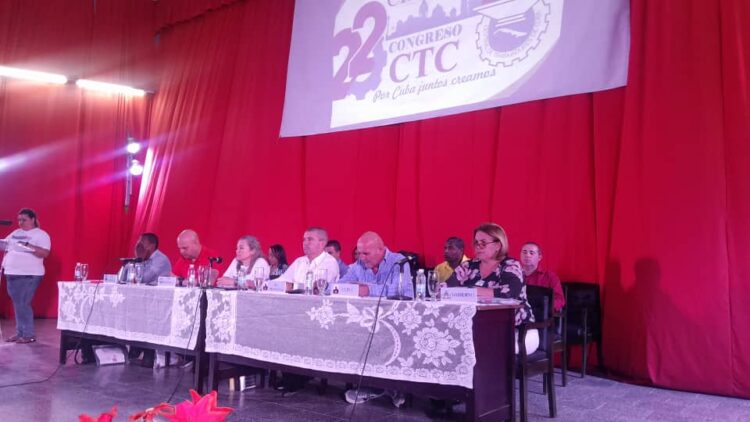
The atmosphere that morning in the south carried shades of dissatisfaction with what has been done in affiliation, cadre policy, internal functioning, and economic contributions amid Cuba’s current context. Several statistics discussed in the first part of the debate confirmed this, showing a decline in affiliation and only 37.4% unionization in the non-state sector.
“We are more credible if we better serve our workers and represent them as they demand. We must create spaces for participation so that the entire union family can find real support for their problems,” commented Colina, who urged never to lose dialogue, now with more information and preparation among leaders.
As essential priorities for the organization, Colina pointed to holding union assemblies, the counterbalance role of administration in management councils, and compliance with collective bargaining agreements. He summed up the ABC of these times in one phrase: “The highest level of participation is building decision-making together.”
Speaking directly and realistically, he noted that the country’s leadership has unlocked much of what companies can do, but union leaders must be better prepared to demand that approved measures be applied in their environment. He cited examples of still very limited economic plans, profit distribution without solving internal problems, and the underuse of land or renewable energy sources in places where they could be applied.
“The main stage today is the workplace collective, and we must all ask ourselves: What can we do for our country and for our workers?” He then updated the people of Cienfuegos on the final process for the 22nd Congress of the , with only two provinces left to hold their conferences (Camagüey and Havana), while confirming that the date of the major event remains set for the second half of June.
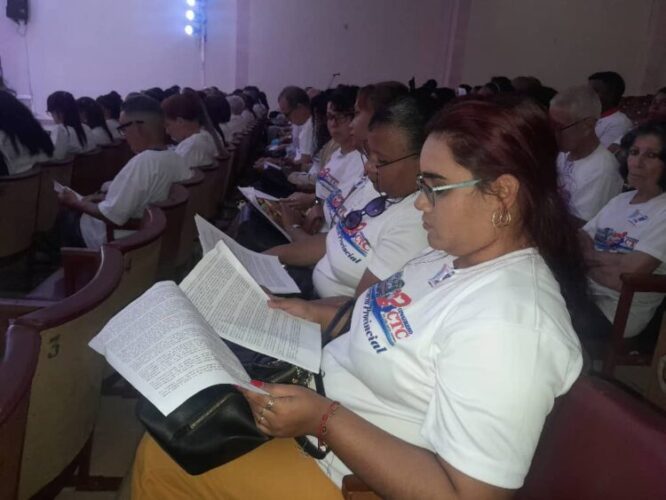
“One of the factors behind the decline in affiliation is the shortage of raw materials in some places, which has led to layoffs and many workers moving to the non-state sector,” explained Leticia Águila Roque, provincial secretary of the Food and Fishing Union, who agreed that grassroots leaders must focus on following up with those workers.
On the example of attention to communication agents, Inés María Abreu, secretary of the Communications Union in the territory, commented: “There was a gap between affiliates in the state and non-state sectors, but we have been organizing and controlling it through the People’s Councils. Today they feel satisfied and pleased with the attention we give them.”
From the health sector, Olga Lidia, secretary of the Union Bureau of Dr. Gustavo Aldereguía Lima Hospital, acknowledged that despite all existing difficulties, her workers continue to provide care 24 hours a day and remain true to Fidel’s words at the hospital’s inauguration: “I take the key and never close the door.”
She recounted everything they have done to not abandon workers in today’s more difficult conditions: joint work with the center’s organizations (UJC, Party, and Management Council), holding union morning meetings with greater participation, and the daily struggle against a minority that tries to overshadow the humanitarian work of the sector.
A strong point was made by Isabel Hernández Cabrera, provincial secretary of the Civil Defense Union, who bluntly stated: “The most important thing for union functioning is cadre policy. We must make that work because that is the heart of the organization.”
Motivated by his predecessors, Andrés Soria Cabrera, from the municipality of Abreu, joined the debate, affirming that affiliation is not just collecting union dues and My Contribution to the Homeland. He insisted that workers must be told everywhere where that money goes, so necessary for the organization. “It must be explained as Martí did with the cigar workers for the war of 1895. This war we will win with ideas. It is not only about affiliating, but about unionizing. Unity is the only thing that will defeat the empire’s aggressions,” he added.
Very enlightening was the intervention of Carlos Rafael Quintero, secretary of the Union Bureau of the Carlos Manuel de Céspedes thermoelectric plant, who informed all present that the synchronization of Block 4 to the national electro-energy system should be completed in the first 15 days of March. “And we did a lot from the union, demanding that the administration make use of the powers granted.”
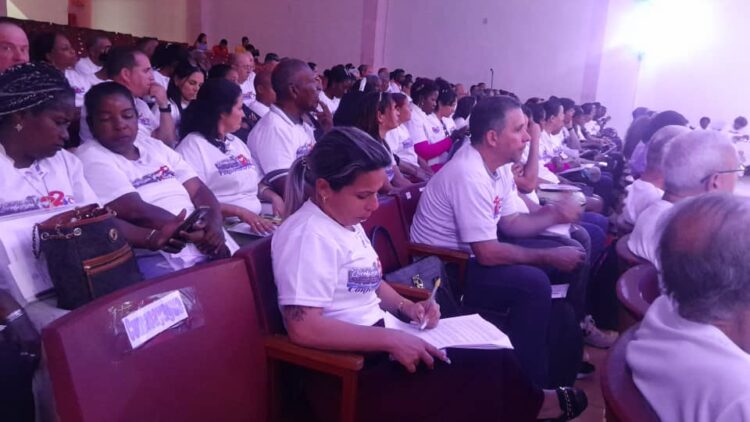
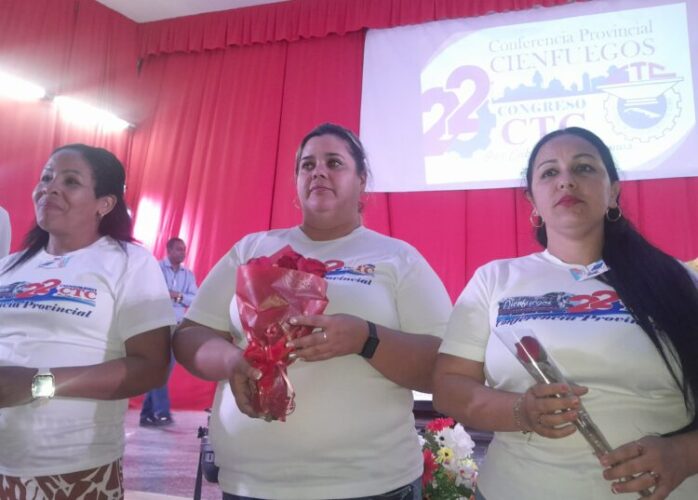
At 40 years old, Anai Morera does not hide that being elected this Saturday as the new secretary of the in Cienfuegos province is a major challenge. She is the logical successor to her predecessor, Mayté Llera Santana, who was bid farewell at the meeting after five years of work in the role.
After 18 years of work in the organization, she shared what particular emphasis she intends to bring to her future mandate based on the report discussed at this Conference:
“I am grateful for the trust placed in me, and we will emphasize, among many other issues, the exemplary conduct of union leaders, closer ties with workers, teamwork, and being proactive to achieve a set of practices that transform the functioning of the organization, so widely discussed in view of our 22nd Congress.”
Her journey through union structures began very young, at just 21 years old. She recounted:
“I started at that age as secretary of the municipal bureau of the metallurgical union; then I spent five years as a member of the secretariat in Cienfuegos municipality, and immediately afterward I was secretary of that municipal committee for five years. Later, I was asked to assume the secretary position of the provincial bureau of the Industry Union, a post I held for only a year before being promoted to the provincial secretariat of the CTC until this February 28.”
Looking ahead to the 22nd Congress of the CTC, she reflected on the role of the organization and Cuban workers:
“The priorities are well defined, and the President of the Organizing Commission outlined them today. The must increase its leadership in society, strengthen its ties with the grassroots, and commit to all tasks without empty words. We must truly represent those who elected us and to whom we owe ourselves.” (Take from Trabajadores)